27 June 2010

350 miles: An Essex Journey: Ken Warpole

After disusing with Tim about my dissertation for my 3rd year i took this book out of the library. After living in Essex my entire life it certainly made me see it differently - beautifully. I also found a blog which is words by Ken Warpole.
http://caughtbytheriver.net/2008/07/estuary-lines-an-essay-on-the-essex-coastline/

The way he describes the coastline around Essex has really made me see it in a different light and i really think this could help me in my reserch for my dissertation.

23 May 2010

Reflecting on Year 2

The writing below was part of my last project for digital media communication called reflecting and projecting I think it does a good job of summing up how i feel about my thinking and thorght process at the end of my 2nd Year!


Garden Designer or Landscape Architect? Well for me this is a very big question after starting my degree on a BSc (Hons) Landscape & Garden Design and then going into the third doing BSc (Hons) Landscape Architecture yes I made the jump to Architecture, and I think that will lead very nicely onto the next chapter of my story. Looking back at this research booklet I’ve realise something; I always think about the wider picture and the point that’s come up most is the fact when designing I feel very strongly about working with the surrounding context and looking at the bigger picture in landscape.
At the start of my degree I remember thinking there was a big difference between Landscape Design and Landscape Architecture but after having two years of intense study and through the many debates with lecturers and other students. I have came to a strong decision that there are actually there is hardly no difference what so ever, apart from the fact architects work with more larger scale projects and designers smaller scale and even then the to professions can cross over. More than anything it excites me to think than I am that beginning of this ever changing colourful profession. So in conclusion I present the following elements to which my thinking and designs have and coming from in the past and what I assume the future will as well as many, many more!

Where am I in my development as a designer and a thinker? Are there common threads in my projects presented? One thing that I have notice through this booklet is actually that there is little reference to people and how they use the landscape and interact with it. Actually that is one of the most important elements to landscape as far as I can see there would be landscapes it there wasn’t people to interact with them and enjoy them the way I do every single day.


How will I take forward all these elements into my Dissertation? Choosing Tollesbury Marina as my dissertation site I feel was a bold move it the fact that I wanted to become a Landscape Architect. I am as ever looking forward to forwarding my studies in the subject. I also think that for me Tollesbury Marina is the prefect place in which to do this, it has so many opportunities and places in which need developing as well as so many connections with the surrounding area which just haven’t been made or have and then been lots. The water also give great opportunities for design as well as the salt marshes and Tollesbury the village itself. From now I really do need to push myself in as many ways as possible to get me up to as higher standard as possible for when I finish my degree and start selling myself to future employes. As previously said I think the most common thread in my work is using the surrounding context of a site and working with it using it to benefit my designs and ideas, and i believe this will carry on being part of my designs. I also think I use a lot of my experience in my life so far to come up with my design although I don’t always express this and I think if I did it would make designs a lot stronger. Well the list of what I’ve learn and developed in the past two years would go on forever, however I feel I’m in a good place in my learning and no doubt I will go on to learn a lot more in my third year in my degree. I would also like to make the aim of doing a lot more reading and researching over the summer.

12 May 2010

Golden Lane Finale

Yes we are there! Yesterday we had our final Critique for the Golden Lane Project and it felt it when very well. I was really pleased with what I have achieved this year and I even though throughout the project I did have doubts on the learning process I can now see the skills I've learn.

In the end i decided to take the concept of well being from the group projects into my detailed design of the area surrounding Great Aurthur's House. I researched into medicinal plants and how people use them, it was all really interesting. For the critque i had 6 square sheets to present my work, the presentation when well and i got some good feedback from the lectures.


Above were three of my final sheets that I presented for the Golden Lane Project!

24 April 2010

Cambridge!


The images above are just a few taken on a visit to Cambridge we took with the College, we visited the Cambridge botanics and accordia housing development, which was very inspiring and interesting to go to. The link below takes you to accordia's own webpage.
http://www.accordialiving.co.uk/

16 April 2010

Visit to Tollesbury

In preparation for my dissertation project in the 3rd year i took another visit to Tollesbury, to get some photos which i am able to work with when researching the site further.
From the images below you really start to get a feel for the sense of place for the area surrounding Tollesbury which will be important to remember when i start looking into the project further.


23 March 2010

Golden Lane Group Work

The Masterplan.
Just thorght I would upload the masterplan that we completed as a group for the Golden Lane project. We got there in the end and I was quite pleased with the outcome of the plan below.

6 March 2010

2000x200 Site Visit

The third project for the digital media module was titled 200 x 2000: A Transect, I choose to look at a old railway line close to my home, the railway used to go from Witham to Maldon in Essex, but i shortened it a little by just looking at the section between Witham to Wickham Bishops. The brief instructed us to look at a site defined as a corridor and should contain a mix of land uses and be monotonus in charater. We were to conduct a site inventory and townscape analysis of the corridor using photographs, sketches, and written observations and then produce various layers for the corridor.
The images below are taken from the site visit I took.


1 March 2010

Community Gardens


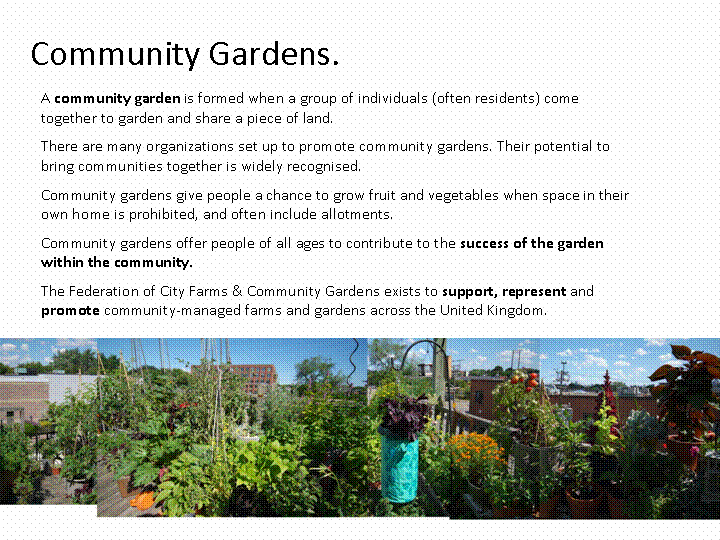
Our group powerpoint on Community Gardens out topic that we were given to research. Something that we all felt we wanted to invole in our Golden Lane Project.


28 February 2010

West 8's Goals & Intentions. "Living in new Jenfeld"

Q: Have another wander around the internet or the library looking at the work of West 8. Charles Waldheim notes on p.46 of his essay "Landscape as Urbanism" that "Taken together, the range of West 8's recent production illustrates the potential for landscape architecture to supplant architecture, urban design, and urban planning as design disciplines responsible for recording post-industrial urban sites." Is there a project in particular that you think illustrates the point well? How does it work? What are West 8's goals and intentions with the project?

Living in New Jenfeld, 2005, Hamburg, Germany.


"In close cooperation with the City of Hamburg and the district Wansbeck West 8 is developing an urban structure for the former casern of Lettow Vorbeck. On 29 hectares, a complete new quarter for living and working will be developed over the next few years.

Row houses with individual brick facades together with typical white detached houses will be arranged around four romantic public spaces. Together the new public spaces will serve as a district park comprising lawns with trees, pavilions, ponds and a water cascade. All storm water will be collected in small trenches along the streets to feed the water cascade and then flow into the central pond, which will act as a water retention basin.
Water is an important feature in New Jenfeld. Besides its sustainable and visually strong impact on the new area it also has an educational function for young children; they learn about the function and flow of the water whilst playing with it.
Other eco-friendly measures are the use of solar cells on top of the roofs of the buildings and high energy building standards that will help create a vital and responsible new quarter."

Info taken from: http://www.west8.nl/projects/sustainable_planning/living_in_new_jenfeld/


I found this project in Germany on West 8's webpage. I love it! To me it links with the question because it has all of the points involed, I think looking through the website a lot of West 8's prjoects relate to the question. But this was one of my favourites! And it relates to my pervious case study on sustainable planning. More places like this need to be considered for the future.
 
Another interest was the only West 8 project in England - the Stratford City. Will definatly keep watch to see how it develops. :)

Hot Houses?? Is This really the answer??


I Found this image in a book on my book shelve ‘Britain from above’ and it made me think of our recent discussions in class. This image was in the a section titled ‘the future’ with this quote beside it ‘As Britons become more conscious of their impact on the environment, the issue of ‘food miles’ - the amount of energy used up in transporting non-seasonal foods from hot climates to our supermarket shelves - is having an increasing effect on our agriculture. Consumers expect out-of-season produce but they want it home-grown, which means that farmers are increasingly looking at ways to extend the season of native crops, and grow non-native crops, using poly tunnels, greenhouses and hothouses. Blue fields of hothouses, like this one in North Kent, are likely to become an increasingly common sight.’ I personally think this is wrong. Ok yes they’ve got the idea that we need to cut down on the air miles but with greenhouses?? NO!! From this quote it made me think hang on all this time I was thinking so if we get people producing the there own food... ‘Closing the loop as such we would be on the right lines for improvement. But no the problem is actually the fact that people want out of season foods?? Bizarre to me, surely in the modern world we live in people should understand that it’s just something that isn’t meant to happen and is just human greed.


Ian Harrison: foreword by Andrew Marr, Britain from above, 2008, Mondadori, Italy.